Workshop om dyrefri antistoffer 22. april 2026 i København
Der anvendes årligt millioner af dyr til fremstilling af antistoffer – kaniner, får, geder, heste og andre dyr. Det sker på trods af, at der findes antistoffer, som ikke er udviklet i dyr. Hvis der var større viden om alternativerne, og hvis man som forsker var indstillet på at søge hjælp og vejledning, så ville meget være nået. Det har Forsøgsdyrenes Værn længe gjort en indsats for at ændre på, og vi gør det i samarbejde med bl.a. Nottingham University og Afability. Vi samlede derfor en kreds af nogle af de mest vidende på området til en workshop i København d. 22. april i år. Vi inviterede den personkreds, som anvender antistoffer i bl.a. forskning og diagnostisk arbejde. Du kan lytte til de enkelte indlæg ved at klikke på billederne og læse mere om indlægsholderne og deres viden om dyrefri antistoffer, som spænder over mange forskellige anvendelsesområder.
Vi indledte denne workshop med at fastlægge den politiske og etiske kontekst og så på hvordan antistoffer, der ikke er udviklet i dyr, i øjeblikket håndteres i nationale strategier og etiske vurderingsprocesser – først i Danmark og derefter i Storbritannien.
Rosemary Goddard Svendsen
Forsøgsdyrenes Værn (The Danish Society for the Protection of Laboratory Animals), Denmark
Fem år efter EURL ECVAM-anbefalingen om anvendelsen af antistoffer, der ikke er udviklet i dyr, ser vi på, om der er sket fremskridt i Danmark?
Dr Alison Gray
University of Nottingham & AFABILITY, UK
AFABILITY og den britiske strategi for erstatning – med fokus på de retningslinjer for erstatning, der er i tråd med 3R-principperne.
De næste indlæg fremhæver to eksempler på akademiske platforme, der anvendes i forskningsverdenen til fremstilling af antistoffer, som ikke er udviklet i dyr. Hvad er allerede videnskabeligt muligt, og hvordan anvendes disse metoder i praksis.
Subrayal Reddy
University of Lancashire, UK
Molekylært aftryk af polymerer leverer alternativer til antistoffer med høj affinitet til diagnostiske anvendelser med mere.
Christian Tiede
University of Leeds, UK
Adhirons er et alsidigt alternativ til antistoffer, som retter sig mod en bred vifte af terapeutiske, diagnostiske og forskningsmæssige mål, og understøtter klinikere, akademiske forskere og industripartnere.
I disse to indlæg fokuseres på hvorledes antistoffer, der ikke stammer fra dyr, omsættes til produkter og tjenesteydelser, og ser nærmere på validering, forsyning, skalérbarhed og de praktiske forhold, der har betydning for slutbrugernes adgang.
David Bunka
Affimer Group, UK
Optimer®-bindemidler som syntetiske løsninger på den globale industris virkelige udfordringer.
Sophie Mayle
Bio-Rad, UK
Fremstilling af skræddersyede, rekombinante HuCAL®-monoklonale antistoffer ved hjælp af in vitro-selektionsteknologi.
Databaser, synlighed og adgang til infrastruktur
Med udgangspunkt i et brancheperspektiv sætter disse to indlæg fokus på den infrastruktur, der i praksis gør det muligt for forskere at finde, sammenligne og fremskaffe antistoffer, der ikke stammer fra dyr – herunder databaser, standarder og servicebaseret adgang.
Pierre Cosson
University of Geneva, Switzerland
Rekombinante antistoffer til den akademiske verden.
Dr Ross Dobie
Centre for Human Specific Research, UK
Database over rekombinante antistoffer og antistof-mimetika: en omdefinering af fremtidens anvendelse af antistoffer inden for videnskaben.
Fra platform til praksis: fælles mål og praktiske løsninger
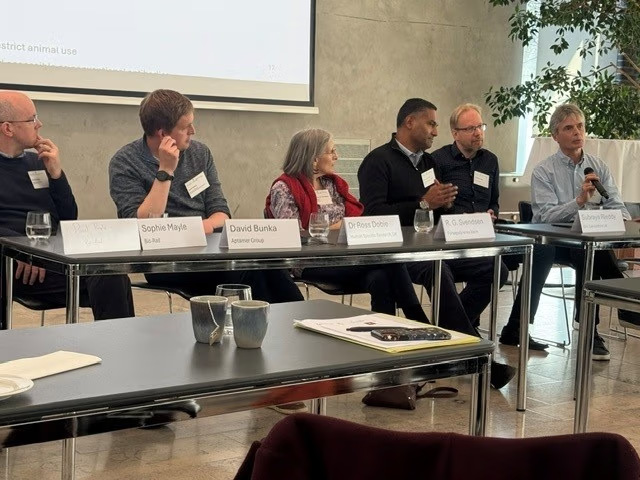
Denne rundbordssnak samler perspektiver fra industrien, den akademiske verden, infrastrukturinitiativer samt politiske og etiske organer. Målet er at bevæge sig ud over diskussionen og identificere konkrete, opnåelige mål og løsninger, der kan anvendes i Danmark – og, hvor det er relevant, også uden for landets grænser. Deltagerne opfordres til at fokusere på, hvilke tiltag der er nødvendige, hvem der er bedst egnede til at føre dem ud i livet, og hvordan fremskridt kan måles.
Round-Table Discussion
From Platforms to Practice: Shared Targets and Practical Solutions.
Læs mere om de enkelte talere.
Herunder kan du læse sammendrag af de enkelte foredragsholderes indlæg.
Rosemary Goddard Svendsen
Forsøgsdyrenes Værn (The Danish Society for the Protection of Laboratory Animals), Denmark
Five years on from the EURL ECVAM recommendation on non-animal derived
antibodies: is there progress in Denmark?
One year after ECVAM published its recommendations on non-animal antibodies, the Animal Experimentation Council, which is the Danish ethical review body, set conditions for new antibody generation licences using animals. These require a person with expertise in non-animal production to be attached to large-scale projects. An annual report must also be given to the animal experimentation authority on which antibody generation methods were used to produce antibodies against which antigens, and on steps taken to end animal use. The maximum antibody generation licence period was reduced from five to three years, though with the possibility of exceptions. From 2021 to December 2025, the number of antibody licence holders using animals reduced from seventeen to nine. This is progress and a further reduction in the number of licence holders is expected in the coming years. However, there are numerous biotech companies in Denmark, many of which use antibodies, but which do not submit licence applications to the Danish animal experimentation authority. Some of these appear to have gone over to non-animal derived antibodies and some not. Yet antibodies, whether animal or non-animal, can be bought from producers in either Denmark or other countries, so the full extent of change to non-animal derived antibodies by all antibody users in the country is not yet clear.
Dr Alison Gray
University of Nottingham & AFABILITY, UK
AFABILITY and the UK Replacement strategy - focusing on a 3Rs-aligned Replacement framework.
This presentation examines how the transition to non-animal-derived antibodies is being translated into practice across the UK and EU. Building on the EURL ECVAM (2020) recommendation, which establishes that animal use for antibody development and production should no longer be authorised without robust scientific justification, recent analyses of UK and EU Non-Technical Summaries—assessed against Animals in Science Committee (ASC, 2022) expectations—are used to evaluate implementation at the point of project authorisation. The findings indicate that while awareness of non-animal methods is widespread, their systematic, evidence-based application remains limited, with justifications for animal use frequently relying on assumption rather than experimental evaluation. In the context of the UK’s 2030 commitment to phase out polyclonal antibody production, this raises important questions about whether current practices are sufficient to deliver genuine Replacement. A structured 3Rs-aligned framework is presented as a practical approach to support evidence-based evaluation of alternatives and operationalise Replacement within project authorisation. Meaningful progress will depend on strengthening evidence requirements and ensuring consistent engagement with available non-animal approaches within decision-making processes.
Subrayal Reddy
University of Lancashire, UK
Molecularly Imprinted Polymers: Delivering High Affinity Antibody Alternatives for Diagnostic Applications and Beyond.
Antibodies underpin modern biomedicine, enabling highly selective molecular recognition across diagnostics, therapeutics, and bioseparation. However, their widespread reliance on animal immunisation, extended production timelines, and inherent instability across temperature and pH regimes present significant scientific, ethical, and economic challenges. These limitations coupled with persistent concerns around batch-to-batch variability have catalysed increasing scrutiny from regulatory bodies and intensified the global search for robust, scalable, and animal-free alternatives. Here, we report a transformative advance in the development of nanoscale molecularly imprinted polymers (nanoMIPs) as next-generation synthetic affinity reagents. NanoMIPs combine the molecular recognition capabilities of antibodies with the intrinsic robustness of synthetic materials, offering exceptional stability, reproducibility, and cost-efficiency. Crucially, we have developed a proprietary manufacturing platform that overcomes longstanding barriers to adoption, enabling the rapid production of high-affinity nanoMIPs in industrially relevant yields (hundreds of milligrams) within a single day. The resulting nanoMIPs exhibit sub-nanomolar dissociation constants (KD), rivalling or exceeding those of monoclonal antibodies, while maintaining high target selectivity. This step-change in production efficiency and performance positions nanoMIPs as credible, scalable replacements for antibodies across a spectrum of applications, including protein diagnostics, biosensing, bio-extraction, and, prospectively, therapeutic targeting. Our approach directly aligns with international policy drivers advocating reduction in animal use and improved reproducibility in biomedical research. Importantly, it also establishes a clear translational pathway for industrial uptake. We are actively collaborating with biotechnology SMEs engaged in antibody production and diagnostic development to validate performance in real-world settings, while simultaneously advancing the formation of a university spin-out to commercialise this platform technology. Collectively, this work bridges a critical gap between academic innovation and industrial implementation, offering a compelling route toward sustainable, ethical, and economically viable alternatives to antibodies in the life sciences.
Christian Tiede
University of Leeds, UK
Adhirons – A versatile alternative to Antibodies.
Antibodies have long been regarded as the gold standard for affinity reagents in research, diagnostics, and therapy. However, despite significant technologicalprogress, their generation still commonly relies on animal immunisation, blood sampling, and subsequent termination, with an estimated one million animals used annually for antibody production across Europe. To address these limitations, we have developed Adhirons, an antibody alternative reagent derived from cystatins, a family of small cysteine protease inhibitors. Adhiron technology offers several key advantages, including: (a) rapid development times (3–4 weeks); (b) high target specificity; (c) exceptional thermal and chemical stability; (d) straightforward engineering; and (e) completely animal-free production in E. coli. We have constructed a phage display library comprising approximately 23 billion Adhirons, enabling the selection of highly specific binders to proteins, peptides, and small molecules. To date, more than 500 successful screens have been completed, and over 50 peer-reviewed publications have demonstrated the robustness of the platform.
David Bunka
Affimer Group, UK
Optimer® binders as synthetic solutions for real-world challenges of global industry.
The need for reliable, ethical, and scalable molecular binders has never been greater, yet conventional antibody technologies remain fundamentally dependent on animal use throughout discovery, development, and manufacture. The Optimer® platform offers a compelling answer: an entirely animal-free alternative that delivers equivalent specificity and superior stability without compromise. Selected through a rigorous in vitro process, Optimers are designed, produced, and scaled without a single animal at any stage of their lifecycle. This talk presents industry case studies that demonstrate the platform's real-world impact: folic acid detection for food fortification monitoring in the developing world; hot-start PCR Optimers replacing two traditional antibodies with a single reagent; and deodorant active binders for Unilever. Together, these examples make the case that animal-free is not just an ethical choice but offers real-world applicability.
Sophie Mayle
Bio-Rad, UK
Generation of Custom HuCAL® Recombinant Monoclonal Antibodies using In Vitro Selection Technology.
High quality phage display antibody libraries can generate very large numbers of antibodies to a given antigen. Manipulation of the screening conditions combined with high throughput screening and characterisation early in the workflow is enables researchers to select the best clones to take forward quickly and cost effectively. In this presentation, Dr Sophie Mayle, Technical Sales Specialist at Bio-Rad Laboratories, will share how Bio-Rad Laboratories is utilising phage display to offer animal free recombinant custom antibody generation services. In addition, the use of SpyTag to allow antibody format conversion without the need for subcloning will be described
Pierre Cosson
University of Geneva, Switzerland
Recombinant Antibodies for Academia.
Where do we currently stand in the field of recombinant antibodies for research? What progress has been made so far ? What challenges remain, and how might they be addressed? In this presentation, I aim to provide a comprehensive overview of the key stakeholders and driving forces shaping the field, while outlining potential directions for future development. One key conclusion is that a global framework is necessary to unleash the full power of recombinant antibodies in the world of biomedical research.
Dr Ross Dobie
Centre for Human Specific Research, UK
The recombinant and mimetics antibody database: Redefining the future of antibody use in science.
Recombinant antibodies and mimetics provide a scalable, ethical, and more reliable alternative to traditional antibodies, yet their adoption remains limited due to low awareness and accessibility. To address this, the Centre for Human Specific Research developed the Recombinant Antibodies & Mimetics Database, an open-source platform which connects researchers to ethically sourced, sequence-defined reagents. With its unique colour-coded system indicating levels of animal involvement, the platform supports more informed choices. In this presentation, I’ll highlight the database’s development, its impact so far, and the key challenges ahead as we work toward making animal-free recombinant and mimetic antibodies the global standard.



 Scan koden med din mobiltelefon